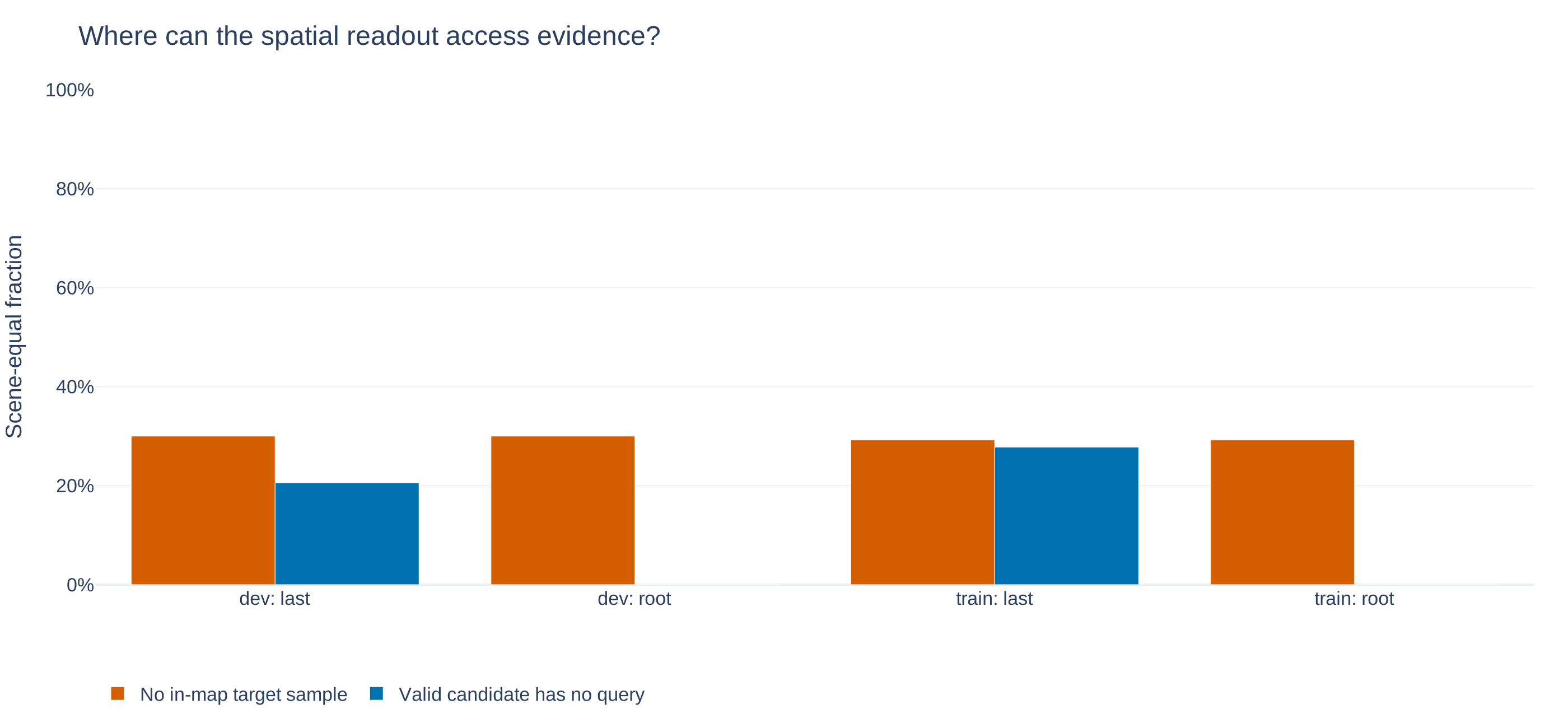
Do not treat the latest run as a data-scale-only problem. The final model fits TRAIN better than a TRAIN-fitted constant, and its TRAIN MSE improves after the selected checkpoint while development MSE worsens. Separately, a frozen-population geometry census finds states where acquired evidence cannot reach the spatial readout: at the last state, all valid candidates have zero in-map target or segment queries in 36/145 TRAIN chains and 3/20 development chains. This is a concrete representation limitation worth addressing before another broad fit. Its contribution to aggregate error and the benefit of a replacement remain untested.
This exploratory, fixed-weight analysis concerns one completed CUDA C1 seed (41), 2,030 successful updates, selected update 1,305, 77 TRAIN scenes and 20 exposed development scenes. It uses the admitted privileged CF-GT selected-depth replay; it is not an end-to-end actor-visible sensor or policy benchmark. It performs no new training or acquisitions. Interactive figures and all tables · portable evidence bundle · source and analysis provenance · experiment index.
Open full-size figure · Interactive view
The census covers root and last state of every frozen chain: 290 TRAIN observations and 40 development observations. These are query-domain fractions, not measured surface coverage or estimated learning effects. Scene means weight physical scenes equally; the 36/145 and 3/20 counts above use chains. Intermediate states were not censused.
The 27 target-lattice points are all outside the fixed chart in 44/145 TRAIN chains and 6/20 development chains. At root, segment queries still give every valid candidate some in-map access; later camera positions can lose that access. At the last state, the scene-equal fraction of valid candidates with no query is 27.8% on TRAIN and 20.5% on development. Raw candidate-weighted fractions differ (1,437/3,589 and 172/477); none is an independent-scene failure probability. Exact census and denominators.
The source-qualified three-scene probe distinguishes failed fusion from inaccessible readout. In scene 81022, last-state fusion contains 3,925 surface voxels and 24,620 free voxels after 15 selected observations, but target and segment query support are both zero. Withholding depth returns leaves its outputs bitwise unchanged. Two other fixed TRAIN scenes retain query access; withholding changes predictions slightly (maximum absolute changes 0.001101 and 0.000475), without changing either chosen action. This three-scene, out-of-distribution missing-return intervention demonstrates frozen-model input sensitivity only. It does not estimate feature importance, population benefit or retrained performance. Acquisitions, poses, prefixes, labels and support remain factual; no acquisition was omitted. Probe outputs · volume evidence · candidate support.
Open full-size figure · Interactive view
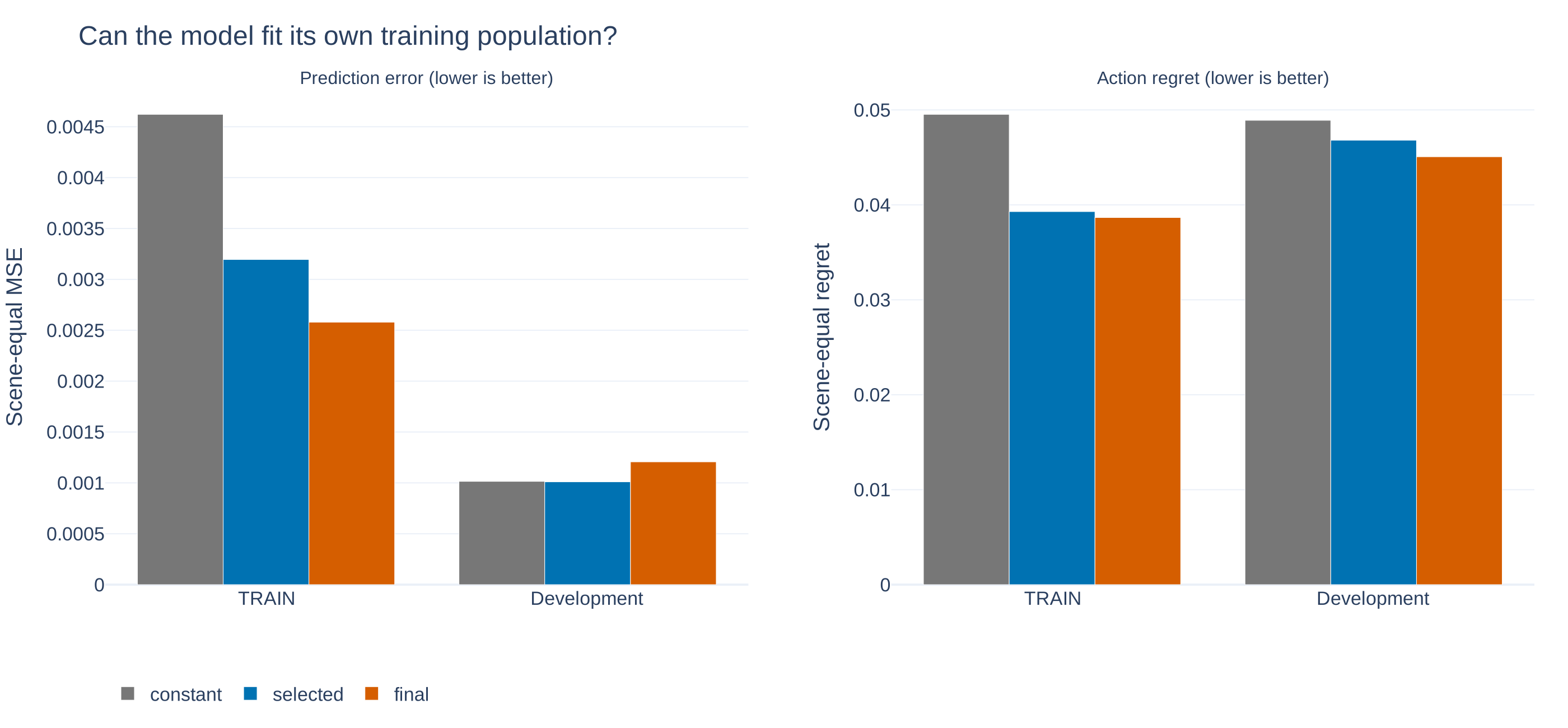
Each candidate error is averaged within a state, states within a physical scene, then scenes equally. All six evaluations use the same guarded GPU evaluator and original labels. The initial mixed-digest batch is superseded. The constant is fitted only on TRAIN; its deterministic tie action is different from uniform choice.
| Population | Checkpoint/control | MSE | MAE | Action regret |
|---|---|---|---|---|
| TRAIN: 77 scenes, 2,320 states | TRAIN constant | 0.004622 | 0.021266 | 0.049531 |
| TRAIN | Selected, update 1,305 | 0.003195 | 0.016484 | 0.039288 |
| TRAIN | Final, update 2,030 | 0.002579 | 0.017356 | 0.038664 |
| Development: 20 scenes, 320 states | TRAIN constant | 0.001015 | 0.016297 | 0.048901 |
| Development | Selected | 0.001011 | 0.012756 | 0.046810 |
| Development | Final | 0.001206 | 0.014234 | 0.045063 |
Regret is the best supported original H1 label minus the label of the greedily chosen candidate; uniform choice averages labels over supported candidates. These are offline recorded-state diagnostics, not closed-loop reconstruction outcomes.
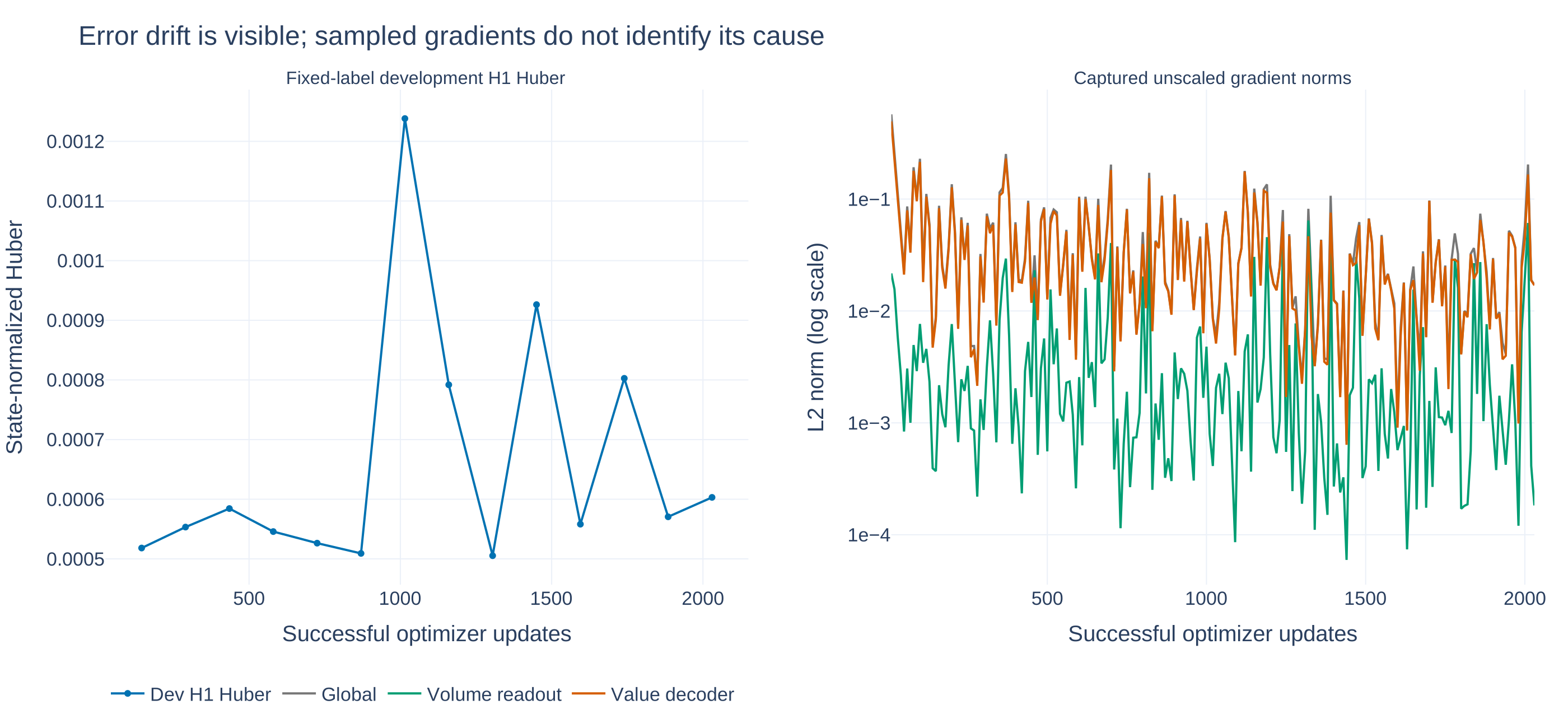
The model is learning something beyond a scalar baseline. Final-minus-selected TRAIN MSE is −0.000616, paired-scene 95% bootstrap interval [−0.001123, −0.000178]; development MSE changes by +0.000196 [0.000082, 0.000331]. This supports a late fitting/generalization or objective tradeoff, conditional on these fixed weights. It does not identify a learning rate, sufficient data scale or causal overfitting mechanism. TRAIN and development have different difficulty distributions, so their absolute MSE levels are not a matched generalization-gap estimate.
MAE and decisions tell different stories. TRAIN MAE worsens late by 0.000872 [0.000075, 0.001653], while development final-minus-selected regret improves by a point estimate −0.001747 [−0.004375, 0.000127]. The latter interval includes zero. Improvement against the deterministic constant must not be reported as improvement against uniform choice; the final-versus-uniform development regret contrast is −0.002835 [−0.006380, 0.000230], which includes zero. Inspect the paired table. These intervals resample entire physical scenes (10,000 draws, seed 20261015). They omit training-seed and checkpoint-selection uncertainty and do not make exposed development scenes untouched confirmation.
A descriptive coverage-stratum check limits the interpretation further. At final weights, last-state MSE is 0.000337 on the 36 inaccessible TRAIN chains versus 0.000185 on the other 109; development has only three inaccessible scenes (0.000294 versus 0.000150 on the other 17). These last-state errors are much smaller than root errors. At roots, zero target-query access is associated with lower TRAIN MSE but higher development MSE, alongside different label spreads. Thus access loss is real, but these observations do not establish that it dominates learning error. Scenes can occur in both TRAIN strata; these are descriptive, difficulty-confounded groups, not independent causal comparisons. Stratum table and exact support.
Open full-size figure · Interactive view
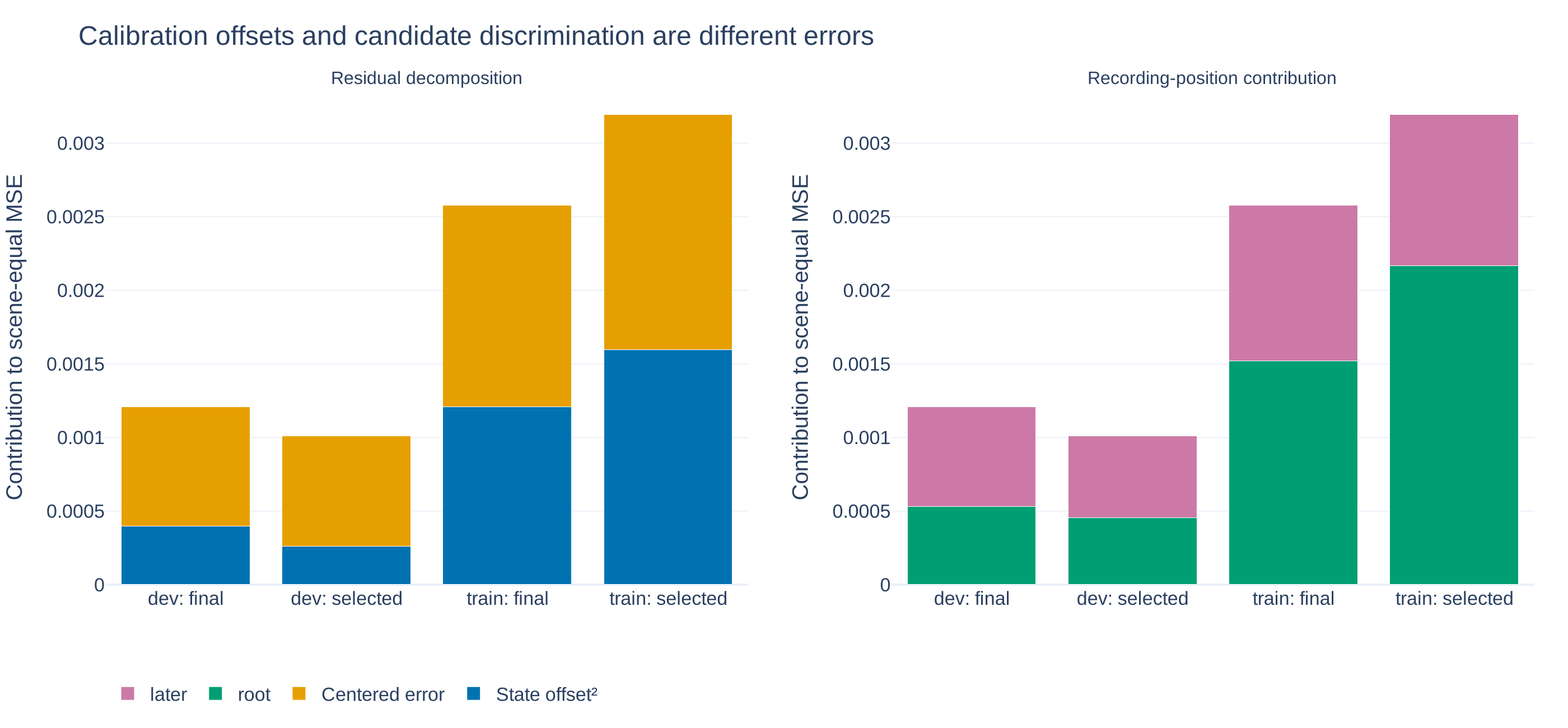
MSE is verified as state-offset squared plus centered residual variance before aggregation. The right panel retains each phase's contribution to total scene-equal MSE instead of renormalizing root and later phases separately.
| Domain | Evidence-supported verdict | What remains unresolved |
|---|---|---|
| Representation | Observed accessibility limitation. The fixed root chart and target/centre-segment readout can provide no spatial sample for a valid action despite integrated selected evidence. | Whether restoring access improves held-out calibration or decisions; whether other physical/history features compensate. Zero out-of-map masking is intentional behavior, not proof of a broken encoder. |
| Optimization | Some fitting; late metric divergence. TRAIN MSE improves, sampled gradients are finite and readout gradients are nonzero. | LR, regularization, effective batch and numerical dynamics are not causally isolated; sparse captures cannot exclude instability between samples. |
| Objective | Different metrics prefer different checkpoints. All evaluated TRAIN/dev residuals remain in Huber(delta1)'s quadratic region. | A smaller delta or ranking term might change emphasis, but neither benefit is tested. No joint feasibility or recursive-QH loss was active in this run. |
| Scale | Independent-scene sufficiency unidentifiable. There are 145 chains on 77 TRAIN scenes, not 145 independent scenes. | A scene-based learning curve and training-seed replication are missing. More chains on the same scenes cannot establish a scaling law. |
| Architecture capacity | No hard output cap found. The regression decoder ends in a linear projection; gradients reach the readout. | Compressed predictions do not prove too little capacity, encoder failure or irreducible uncertainty. The accessibility defect needs a controlled test first. |
Training presents one complete chain per update, so scenes with more chains receive more presentations; the scientific scorecard instead weights scenes equally. Final TRAIN state-weighted MSE is 0.002507 versus scene-equal MSE 0.002579. This exposes an estimand difference, not a tested advantage for a different sampler. Roots are only one of sixteen recorded states, but their larger residuals can carry substantial quadratic loss.
Root errors are large but do not all move together. TRAIN root MSE improves by 0.010373 after selection; later TRAIN MAE worsens by 0.002158 [0.001479, 0.002860]. Final development root MSE is 0.008476 versus later-state MSE 0.000722. This phase split motivates separate root/later monitoring and a controlled exposure comparison. Root-error stratification remains evaluation-only, separate from actor inputs. Phase table.
Open full-size figure · Interactive view
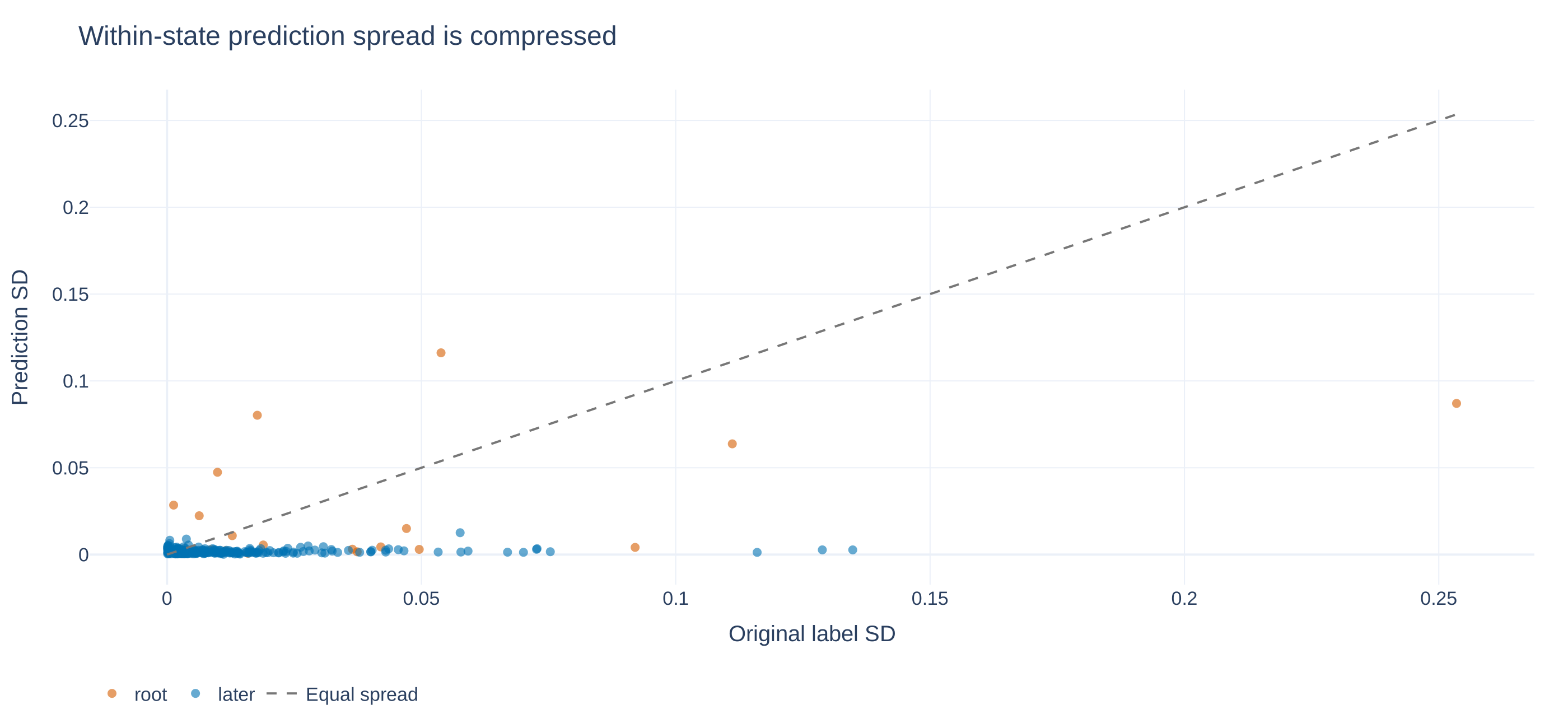
All 320 development states are shown at final weights; roots and later states have different label ranges. Candidate rows and states are dependent. Lower within-state prediction spread does not itself establish a defective architecture or an optimal ranking loss.
Open full-size figure · Interactive view
Fourteen native validation checks retain their original successful-update coordinates. The gradient view contains 203 distinct captured task-diagnostic updates, not 1,939 independent transport observations. A plotted line connects sparse captures; it does not reconstruct intervening updates.
Executed configuration is AdamW, LR 0.0003, weight decay 0.001, batch
one complete chain, direct H1 Huber(delta1), zero auxiliary weights and
no active scheduler. Training used 16-mixed precision,
clipping norm 1 and accumulation 1; the new fixed-weight comparisons use
FP32 with highest matmul precision. The frozen model uses attention
width 32 with four heads, decoder hidden width 128, dropout 0.05 and
mean-pooled pose history. The fit completed 14 epochs. The generic
OneCycle fields do not mean OneCycle ran. Selection used validation
loss, with patience five; final weights remain primary and selected
weights secondary. There is no retrospective reselection.
Task diagnostics occur every ten successful updates. Captured global unscaled gradient norms range from 0.000688 to 0.571581; captured readout norms are nonzero. Pre/postclip values agree at these task captures. Other optimizer-callback observations exceed one, so this does not mean clipping never occurred. Historical callback fields lack their own observation coordinate and cannot safely borrow a carried task counter. The patch adds a zero-based attempted-step coordinate prospectively; it changes no gradients, clipping or updates. Missing AMP skip/scaler records are not measured zero skips. Unique diagnostic observations.
| Availability | Metric / owner | Required use before the next run |
|---|---|---|
| Retained and admitted | 14 H1 validation checks; 203 task gradient/output captures; executed LR/objective/config; native update count | Preserve source ordinals, capture coordinate and multiplicity; distinguish validation selector from final role. |
| Newly recomputed | Full fixed TRAIN/dev MSE, MAE, bias, offset/centered error, spread, margins, pair ordering, regret and uniform control; support and root/later fractions | Evaluate identical checkpoints and original labels. Existing native evaluator plus the new full-TRAIN role now supports this. |
| Newly recomputed | Root/last query accessibility and bounded selected-return sensitivity | Run geometry preflight on each proposed population/representation. Report out-of-map, unknown in-map and measured support separately. |
| Configured / partial retention | Callback global/block gradients, clipping and optimizer metadata | Log each payload's own attempted and successful coordinates. Do not count carried rows as new measurements. |
| Prospective | Successful versus attempted updates, skips/scaler, examples/chains/states presented, actual LR, gradient zero/nonfinite fractions, update/weight ratios | Retain at a declared cadence, with a bounded overhead budget and explicit failure receipt. No historical interpolation. |
| Prospective when needed | Input/volume/encoder/decoder/backward/validation timing; full-transaction peak allocated/reserved memory | Measure synchronized representative shapes before changing batch or claiming throughput/capacity. The ≈1.1 GB inference allocation is not training capacity. |
| QH only | Target/online lag and target drift, per-horizon support, fixed-label H1, exact-backup versus predicted-Q2 error, joint component gradients | Add only for a separately commissioned QH question; moving targets and scalar loss shares cannot establish interference or policy value. |
Instrumentation overhead has not been benchmarked as a production throughput result. Freeze cadence and an acceptable overhead threshold before any new fit, rather than enabling every diagnostic by default.
These are provisional sampling proposals, not enabled defaults or
retained measurements. Paths below are relative to
aria_nbv/aria_nbv/ unless prefixed with
scripts/. The named owners are where an extension belongs;
an owner does not imply every listed field is already emitted. Freeze
cadence, parameter/feature rosters and acceptable overhead in the next
authorized protocol before fitting. Incremental instrumentation
overhead is unmeasured for every group below.
| Metric group | Implementation owner | Provisional cadence | Cost / overhead status | Decision it informs |
|---|---|---|---|---|
| Attempted/successful updates, AMP skips/scaler, actual LR; chains, states and candidates presented versus supported | lightning/finite_horizon/module.py:
training_step, _record_optimizer_update;
lightning/training/gradient_logging.py |
Counters/scaler/LR at every attempted update; presentations at every batch; always retain failure context | Scalar bookkeeping plus device synchronization where required; incremental wall time unmeasured | Separate insufficient exposure, effective batch and skipped/nonfinite transactions from fitting failure |
| Unscaled pre/postclip global and encoder/readout/fusion/decoder norms; zero/nonfinite gradient fractions | lightning/finite_horizon/module.py:
on_before_optimizer_step;
lightning/training/gradient_logging.py |
Every 10 successful updates, each payload carrying its own attempt and success coordinates; failure capture always | Parameter reductions and synchronization; split the current coarse readout group prospectively; overhead unmeasured | Localize weak/nonfinite gradient paths and clipping; do not infer importance from norm size |
| Prediction/target quantiles, within-state spread, Huber-region fraction and root/later support | lightning/finite_horizon/module.py:
_log_q1_output_diagnostics;
lightning/finite_horizon/studies/q1_learning_dynamics.py |
Bounded detached summaries every 10 successful updates; fixed-probe reductions at evaluation checks | Candidate reductions and bounded capture; overhead unmeasured | Detect tail-driven quadratic loss, compressed predictions and phase-specific calibration drift |
| Fixed-label MSE/MAE, bias, offset/centered error, margins, ordering and regret versus constant/uniform | lightning/finite_horizon/diagnostics/evaluation.py;
lightning/finite_horizon/studies/q1_learning_dynamics.py |
Predeclared fixed TRAIN probe plus full dev every 145 successful updates (one epoch in this frozen run); full TRAIN/dev at selected and final weights | Additional whole-chain inference; existing evaluation timings are not an incremental-overhead benchmark | Distinguish fitting, calibration and ranking at common checkpoints; label the small TRAIN probe separately from full TRAIN |
| Per-module feature availability/norm/variance; selected-return sensitivities; target/segment in-map, unknown and measured support | vin/diagnostics/model_inspection.py,
vin/diagnostics/qh_evidence.py; native geometry in
vin/geometry/{volume_fusion,qh_queries,voxel}.py; frozen
reference scripts/audit_q1_query_coverage.py |
Geometry preflight before each new population/representation; same fixed TRAIN roster at selected/final checkpoints for feature probes | Geometry scans or extra whole-chain forwards/capture; overhead unmeasured | Separate absent/inaccessible input from learned feature behavior; qualify frames/bounds before changing capacity |
| Parameter update/weight ratios and optimizer moments | lightning/finite_horizon/module.py:
training_step, _record_optimizer_update;
optimizer-metadata seam in
lightning/training/gradient_logging.py |
Every 100 successful updates on a frozen named-parameter roster; no historical interpolation | Parameter snapshots/moment reductions consume memory and synchronization; overhead unmeasured | Observe actual optimizer movement when LR/regularization or AMP remains a leading hypothesis |
| Input, volume, encoder, decoder, backward and validation timing; peak allocated/reserved memory, throughput and headroom | lightning/finite_horizon/experiment.py,
lightning/finite_horizon/module.py;
lightning/training/trainer.py owns trainer
construction |
One separately authorized bounded capacity/profiler session before a resource/model/precision/batch change; record all declared complete transactions, warmups and failures | Synchronization/profiling can perturb runtime; full optimizer transactions require their own gate; overhead unmeasured | Admit safe shapes and effective-batch controls; inference peaks do not establish training capacity |
| QH-only target/online lag and target drift, per-horizon residual/support, fixed H1 and exact-backup versus predicted Q2; joint component-gradient norms/cosines | lightning/finite_horizon/{module,objective}.py,
lightning/finite_horizon/diagnostics/history.py;
_component_gradient_evidence in module.py |
Scalar lag/support summaries every 10 successful updates and native validation checks; component gradients on fixed checkpoint probes until overhead is qualified; failure capture always | Extra reductions and potentially multiple gradient traversals; overhead unmeasured | Separate target movement, support and prediction error; test local joint-gradient behavior without equating it to causal interference or policy benefit |
If a proposed group exceeds its prospectively frozen overhead or retention budget, reduce its roster/cadence under a recorded protocol amendment rather than silently dropping values or treating missing fields as zero. This inventory commissions no fit, profiler optimizer transaction or QH run.
All three require a concrete prospective protocol. New training, optimizer transactions (including a temporary capacity canary), rollout collection, merge and deployment retain separate authorization gates. Before a fit, execute the full capacity protocol with representative maximum admitted chains, frozen precision, controlled warmup/cold states, complete optimizer and validation transactions, peaks/headroom and failure receipts. Current inference does not clear that gate.
The matched Mac Q1 comparison increased R1 chains from 77 to 145 on the same 77 TRAIN scenes. It did not clear its frozen retention gates: final MAE worsened, and the regret contrast remained uncertain. Its zero auxiliary losses also exclude active joint-BCE competition for that fit. CUDA changes backend/precision, exposure and selection opportunities; its different point estimates are not a causal backend or hyperparameter comparison.
The larger Q1 and interrupted QH synthesis and failed-QH diagnostics preserve separate dispositions. Continuing QH failed; long-horizon fitted residuals and weighted BCE share cannot identify a failure mechanism. The present pure-H1 controls already identify a concrete next representation test, so another QH inference campaign is not needed to rank that test. No failed run becomes a completed comparison.
Start with the VIN package and finite-horizon package, then follow the Method-to-code pairs below.
| Reading question | Thesis owner | Implementation owner / distinction |
|---|---|---|
| What enters a candidate value? | Method overview, then descriptor plan | aria_nbv/vin/models/target_volumetric.py: factual root/selected depth, physical/history descriptors and requested horizon remain separate from privileged labels. |
| Which attention is used? | Architecture contract | vin/models/target_spatial_query.py: A1 candidate-to-four-state-token fusion. vin/modules/qh_volume_readout.py: candidate-local spatial attention. These are distinct modules. |
| Where can spatial evidence be read? | Representation comparison, then interaction comparison | Frozen measured_evidence_v2, 48³ grid, width16 encoder,
27 target and 16 centre-segment samples,
legacy_attention_v1. Current weighted pooling/attention
alternatives exist but were not evaluated here; calibrated multi-ray
reading remains a separate proposal. |
| What is optimized, and what is QH? | Value learning | lightning/finite_horizon/objective.py and module.py: this run uses only direct fixed-label H1, without recursive targets or active feasibility auxiliary. The finite-horizon package name does not imply this fit used QH recursion. |
| Finding | RQ | Thesis owner | Coverage / gap |
|---|---|---|---|
| Valid-action spatial query access can vanish despite fused selected evidence | RQ2/RQ3 | Method representation comparison; Results/Discussion | New fixed-population diagnostic; learning benefit of correction untested. No thesis prose changed in this diagnosis. |
| TRAIN fitting and later development MSE drift coexist | RQ3 | Results one-step diagnostics | One exposed-development seed; no policy or training-seed conclusion. |
| Calibration, root/later error and greedy regret require separate monitoring | RQ3 | Value-learning evaluation; Discussion | Reusable full-TRAIN controls added; ranking-loss benefit untested. |
| More chains is different from more independent scenes | RQ2/RQ3 | Experimental design | Matched Mac negative retention plus new CUDA support; independent-scene scaling curve missing. |
The closed CUDA adapter authenticates 13 independently pinned metadata files, both checkpoints, producer revision, terminal fit/selection history and original support before numerical reduction. Fresh TRAIN evaluations admit 2,320 states and 79,643 candidates; development admits 320 states and 11,444 candidates. All planned states are admitted in these evaluations. Selected/final and controls join by physical scene, store, rollout, state and original candidate/label support. Optional ordering metrics have their own supported denominators. No unsupported state becomes zero error.
The six guarded neural inference receipts bind the frozen diagnostic source. The six inference receipts share its reconstructed 515-file package digest. Subsequent scalar reductions and presentation have separate source hashes in provenance. The first mixed-digest inference batch is retained privately as superseded; its predictions reproduce exactly in the guarded repeat, which is not an independent training replicate.
The TRAIN-only constant is 0.014635580165521042. Labels and
checkpoint predictions stay private; portable tables contain derived
scalar observations, not raw vectors. Immutable cold bundle contains the same
scalar tables and five Plotly definitions; the generic
read_report_bundle verifies it without private stores. Interactive view preserves zoom/hover. Analysis provenance binds table,
input, telemetry, protocol and producer digests. The written public analysis protocol names the units, frozen
probes and limits.
The strict predeclared CPU/GPU probe failed rtol1e−5/atol1e−6 (maximum absolute difference 3.200024e−6), with zero chosen-action changes on its chain. Separately, saved original development predictions versus fresh GPU predictions differ by at most 7.621944e−5 at selected weights and 2.456605e−4 at final weights, with zero chosen-action changes across each 320-state set. These checks do not establish backend equivalence. New contrasts use their common GPU evaluator; original values remain separately labelled. Backend readback.
Repeated ordinary feature controls and root missing-return controls agree bitwise. Parameter/buffer bytes, module modes and RNG states remain unchanged. Query census uses native chart/query/sampler geometry without encoder inference; the fixed chart applies throughout a chain. Native source originals, historical reports, user annotations and accepted thesis abstract remain preserved. No training, optimizer update, collection, deployment or merge was performed.
Full tables: scorecard, support/exclusions, states, scenes, phases, paired contrasts, native validation, captured diagnostics, query census, census reductions, coverage strata, feature probe, volume support, candidate support, backend readback.
The retained feature and geometry probes predate diagnostic package attestation. Their recorded script, checkpoint and population checks remain available, but do not establish the package bytes used at execution. Future captures require guarded implementation identity; legacy readback explicitly records this limitation.