The matched Mac fits learned early calibration but drifted later. More R1 trajectories on the same scenes did not clear the frozen scientific retention gates. This is a completed one-step comparison, not evidence for a multi-step policy or a preferred architecture.
C0 trained on 77 historical R1 chains; C1 used 145 chains across the same 77 TRAIN scenes. Both completed 3,120 updates with seed 41, MPS FP32, batch one and direct scalar Huber loss. Auxiliary losses were zero. C2's lower learning rate completed only an engineering check; no completed C1/C2 scientific comparison exists.
Open full-size figure; zoom to inspect labels
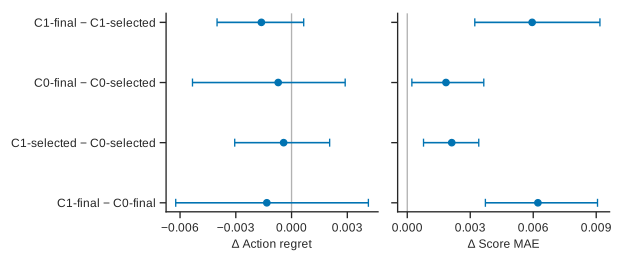
Regret is the best available labelled immediate gain minus the gain of the chosen candidate; lower is better. MAE is mean absolute prediction error and measures calibration, not action choice. Dots/intervals concern the 20 exposed validation scenes, with states and candidate rows nested inside scenes.
C1 final−C0 final regret is −0.001331 [−0.006233, +0.004134], a 2.9% point reduction below the 5% retention gate. MAE worsens by 0.006222 [0.003721, 0.009062], exceeding the matched-control cap. Neither final model's regret-versus-uniform interval excludes zero. These fixed-weight paired scene intervals omit training-seed and checkpoint-selection uncertainty.
Open full-size figure; zoom to inspect labels
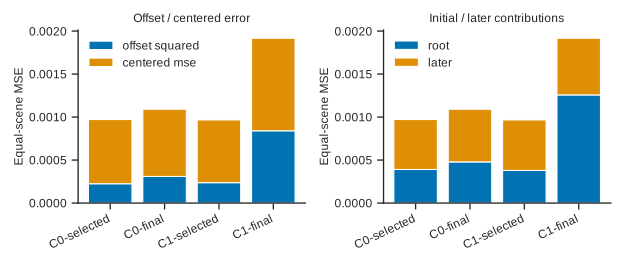
MSE separates squared state-wide offset from centered candidate-error variance. Phase bars use equal-scene weighting; initial states are 20 of 320 observations. They contribute 65.6% of C1 final squared error and 92.5% of its selected-to-final growth. These descriptive contributions do not establish causal training importance or identify why the representation or optimizer fails.
C1 changes 182 of 320 selected actions between selected and final weights: 75 improve, 94 worsen, and 13 change to tied-value candidates. Counts do not encode gain magnitude. A state-wide offset changes calibration without changing candidate ordering, while centered error remains. All retained validation residuals are in Huber's quadratic region, and no QH or feasibility-BCE term was active. Joint-loss interference therefore cannot explain this particular fit by active loss competition.
Next: qualify fixed-checkpoint full-TRAIN/dev evaluation before calling the behavior a generalization gap. A TRAIN-fitted constant and feature-use controls distinguish calibration from representation hypotheses. The newer CUDA C1 changes precision/backend, exposure and selection opportunities and must remain a separate descriptive attempt; see the bounded CUDA disposition.
All eight interactive figures and eleven complete tables. This view consumes the unchanged, independently admitted snapshot.
Native
publication and reproduction links the immutable
analysis.json, independent manifest pin and authored
context. read_mac_q1_publication recovers the typed
snapshot: 11 tables and eight Plotly inputs. Existing static figures and
full interactive originals remain accessible. Candidate evaluation
vectors, checkpoints and raw run controls are private and are not
reconstructed from publication hashes.
| Finding / evidence | RQ | Thesis section | Coverage / gap |
|---|---|---|---|
| Matched trajectory-expansion comparison | RQ2/RQ3 | ssec:mac-q1-comparison | Partial: negative retention result integrated; cause and policy benefit missing |
Previous primary report retains its complete narrative, exact tables and original figures. This 15 October revision is an authored synthesis, not a new experiment or a change to the numerical snapshot. Original sealed report.
Experiment index and evidence routes. Missing/private parents remain explicit in the native campaign owner; historical versions retain their original dates and scientific identities.
Scientific snapshot and attempt identities remain those of the cited experiment. Report synthesis: 15 October 2026; restored to the domain/date owner: 16 October 2026.