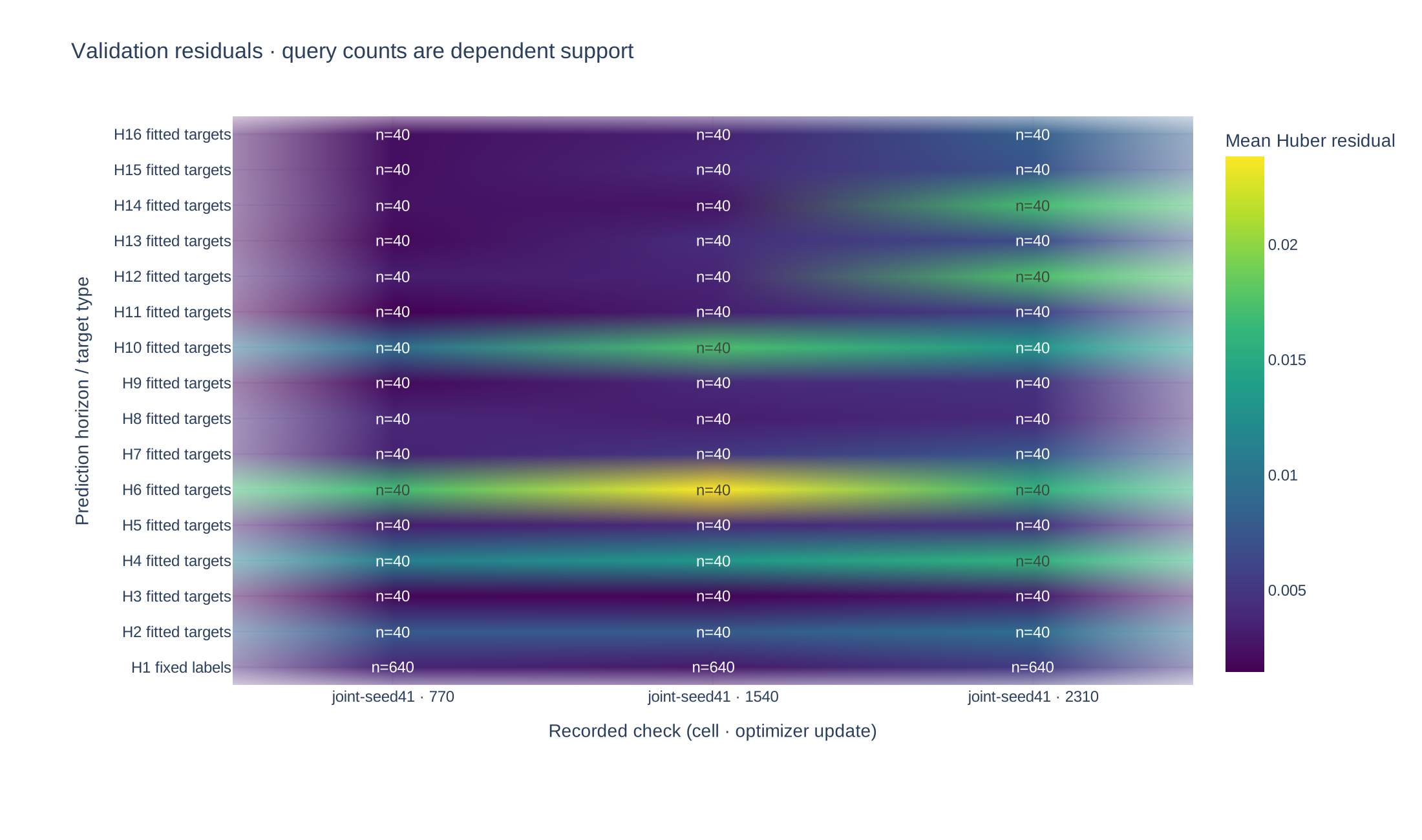
The traces localize increasing fitted residuals, but do not identify a causal failure mechanism. This support report concerns one incomplete seed and three retained validations; it is not a completed QH policy study.
Open full-size figure; zoom to inspect labels
H12–H16 contribute about 64% of the increase in mixed fitted residual, under different state-query phases. Longer-horizon targets move during fitting. The heatmap therefore cannot distinguish target drift from prediction failure by itself.
Weighted operational-feasibility BCE contributes a median 56.6% of logged combined batch loss. This is a scalar weighted loss share, not a shared-gradient share. Sampled gradients remain below clipping norm one, but sparse observations do not reconstruct the failure-time batch or rule out unobserved instabilities.
The cloud capture contains 4,938 complete rows, including 2,300 carried diagnostic rows representing 123 distinct run/update coordinates. Repeated transport rows are not independent optimization measurements. Native source ordinals and multiplicities remain in the complete diagnostic view.
Next: inspect complete finite precision transactions and shared-gradient support under a prospective protocol. A cosine or scalar share alone cannot show long-term interference. The main Q1/QH synthesis keeps this failed attempt distinct from subsequent engineering completions and the zero-auxiliary Mac Q1 fits.
The history/cloud bundles beside the original report preserve
admitted observations, namespace and terminal bounds. Use the existing
scorer diagnostic builders and read_report_bundle; the
historical public QH mission is unavailable. No new fit, retrospective
selector or loss-weight change is made here.
| Finding / evidence | RQ | Thesis section | Coverage / gap |
|---|---|---|---|
| Scalar loss share and moving-target residual | RQ3 | sec:thesis-discussion | Partial: failure interpretation; causal interference remains untested |
Previous primary report retains its complete narrative, exact tables and original figures. This 15 October revision is an authored synthesis, not a new experiment or a change to the numerical snapshot.
Experiment index and evidence routes. Missing/private parents remain explicit in the native campaign owner; historical versions retain their original dates and scientific identities.
Scientific snapshot and attempt identities remain those of the cited experiment. Report synthesis: 15 October 2026; restored to the domain/date owner: 16 October 2026.