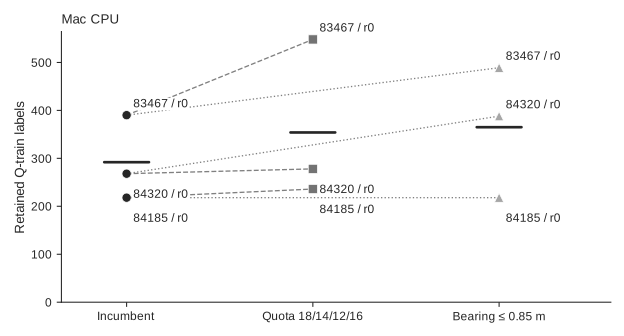
Both nominated changes retained more training labels on three matched Mac roots. The pilot does not establish a better collector: endpoint effects differ by scene, and learning benefit was not tested.
The 12 October pilot completed nine cells: three physical scenes, one root per scene, one proposal/selection seed, and three profiles. Each used H16, 60 allocated candidates, the same initial root/target assignment, measurement and motion bounds. The quota arm changed only 18/18/12/12 to 18/14/12/16; the radius arm retained the original quotas and changed bearing radius from 1.1 m to 0.85 m. CUDA execution was prepared only.
Open full-size figure; zoom to inspect labels
The root-level marks expose heterogeneity behind the totals. The incumbent retained 876 labels, the quota arm 1,062 and the radius arm 1,095. Each profile had 2,880 allocated candidates over 48 supported states. These are operational supervision counts, not additional independent scenes or observed learning gains.
The independently measured endpoints vary substantially by scene: scene 84320 has very small gains around 0.00017–0.00064, whereas scene 83467 spans approximately 0.511–0.627. A higher total label count cannot certify that the additional choices resolve harder reconstruction decisions.
Open full-size figure; zoom to inspect labels
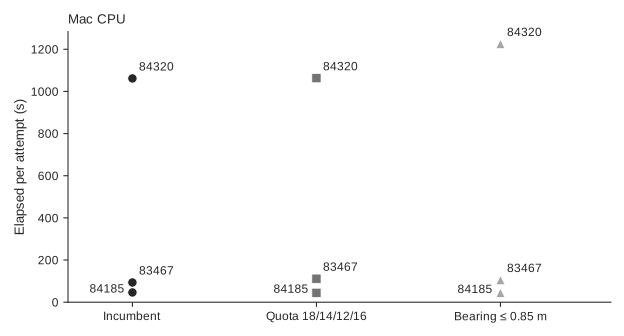
All-attempt elapsed totals are 1,201.24 s for incumbent, 1,218.93 s for quotas and 1,373.90 s for radius. These observations include the declared concurrent Mac context; they are not controlled cross-host performance estimates. The native report supplies qualified scene-paired contrasts without population confidence intervals.
The generation census explains why these two interventions were nominated before validation exposure. This pilot supplies a small matched follow-up, not permission to tune a new mixture from validation or to pool Mac and CUDA stores.
Next decision: repeat separate interventions across additional independent TRAIN scenes and seeds under frozen endpoint and all-attempt cost rules. A quota objective should guard useful exclusive alternatives and diversity as well as supported-label yield. Test downstream learning separately, with equal exposure and unchanged validation selection. Retain exploration in every family; do not turn a percentage yield advantage into the same percentage quota increase.
The frozen
protocol and sealed native report
retain all nine outcomes and pairing dispositions.
read_saved_r1_ablation_report is the domain cold reader;
aria_nbv.reporting.r1_supervision.render_saved_report
reuses its supplied reductions and plots. Re-rendering does not launch
CUDA or recompute source stores.
| Finding / evidence | RQ | Thesis section | Coverage / gap |
|---|---|---|---|
| Matched quota/radius pilot | RQ1 | ssec:r1-collector-pilot | Partial: bounded pilot integrated; population/learning benefit missing |
Previous primary report retains its complete narrative, exact tables and original figures. This 15 October revision is an authored synthesis, not a new experiment or a change to the numerical snapshot. Original sealed report.
Experiment index and evidence routes. Missing/private parents remain explicit in the native campaign owner; historical versions retain their original dates and scientific identities.
Scientific snapshot and attempt identities remain those of the cited experiment. Report synthesis: 15 October 2026; restored to the domain/date owner: 16 October 2026.