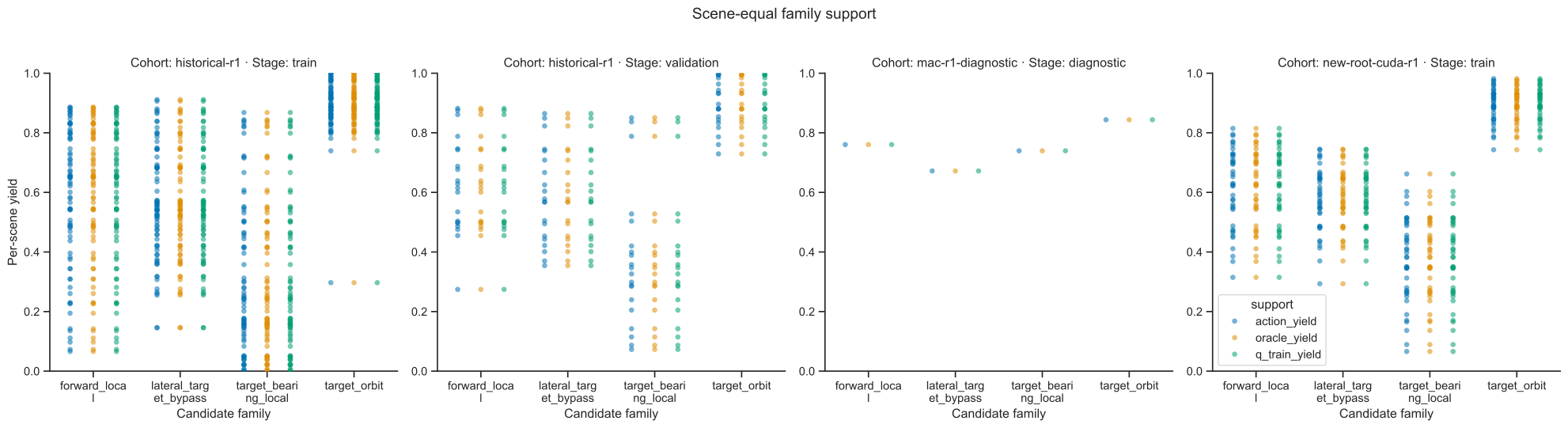
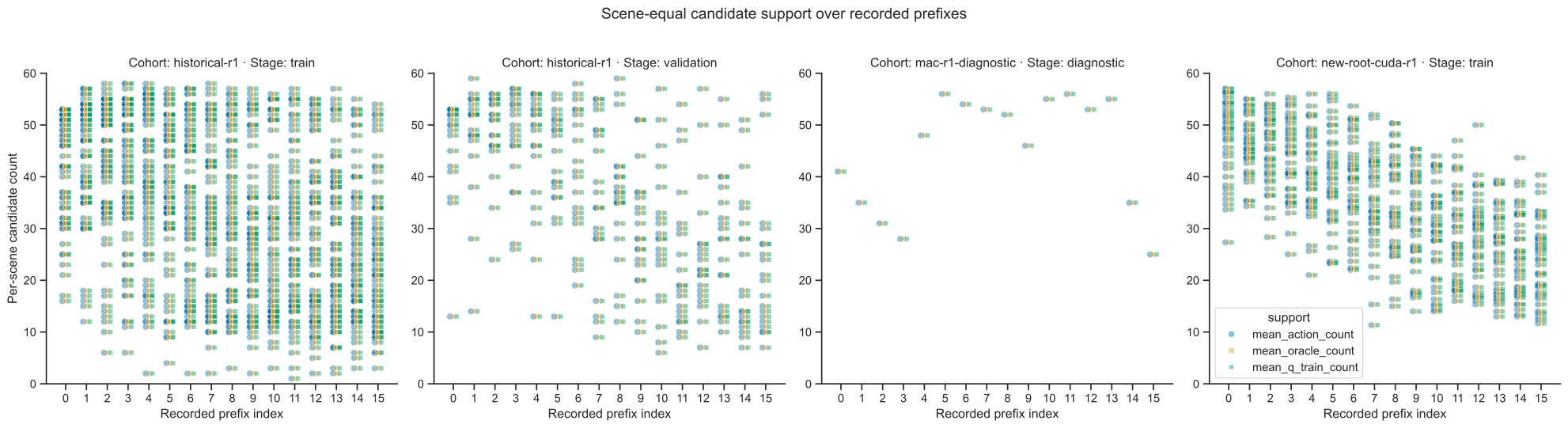
The incumbent recipe loses supported choices in two places: bearing proposals frequently lack training support, and later recorded acquisitions offer fewer supported alternatives. Neither observation establishes that sixteen acquisitions are unnecessary.
The 11 October census contains 215 completed chains, 3,436 recorded states and 206,160 candidate rows. Its 194 TRAIN chains comprise 77 historical R1 chains and 117 incremental CUDA chains on 40 of the same TRAIN scenes. Twenty exposed validation chains and one separate Mac diagnostic are not additional TRAIN evidence. Scenes, rather than repeated candidate rows, receive equal weight within each cohort.
Open full-size figure; zoom to inspect labels
Bearing training-label yield is 31.4% in historical TRAIN and 37.1% in incremental TRAIN; orbit yields are about 89% in both. These fractions describe the incumbent allocations. Unequal proposal counts, geometry and selection exposure prevent interpreting the difference as a causal allocation benefit.
The TRAIN-only nominations were a quota change from 18/18/12/12 to 18/14/12/16 and a separate bearing-radius change from 1.1 m to 0.85 m. The three-scene R1 pilot subsequently tested those exact changes. It retained more labels in both arms but heterogeneous endpoints; a training benefit remains untested. The older geometry-only Phase-A failures have no reward labels and cannot be pooled with this census as reward-opportunity evidence.
Open full-size figure; zoom to inspect labels
Later support is conditional on recorded states and finite labels. In exposed validation, the scene-equal supported count falls from 46.7 at the first position to 23.85 at the sixteenth; the finite gain p90–p10 span contracts from 0.059607 to 0.004429. These describe different positions of factual histories, not randomized recording budgets.
The separate historical prefix summary retains a positive median of source-root median paired H16−H12 cumulative gains of 0.02619 across 71 roots, derived from 156 H16-complete stores. This historical evaluator is a diagnostic proxy without independent endpoint measurement. It shows that the tail was not uniformly redundant on that survivor population. It cannot establish an optimal cutoff or be combined with the newer R1 census. Missing later states remain unknown.
Decision: retain H16 as the recorded evidence contract while testing whether shorter acquisition yields more useful independent experience per cost. First align common factual risk sets, prefix clocks and independent endpoints. Vary recording length separately from requested prediction horizon. No collector parameter is promoted here.
The public findings provide the exact
displayed values. The original
protocol and archive identify the 215-chain product and its inputs.
aria_nbv.reporting.generation_posthoc.read_generation_posthoc_report
cold-reads its tables and six figures;
write_generation_posthoc_report renders admitted evidence.
generation_thesis provides the existing scene-level family
and prefix figures. Raw stores and parent-context availability remain
distinct from the portable tables.
The source-bound protocol records the present questions and missing counterfactuals. Training-record subsampling can retain real acquisition histories; omitting acquisitions needs reconstructed state and recomputed targets. A gain from either remains a hypothesis.
| Finding / evidence | RQ | Thesis section | Coverage / gap |
|---|---|---|---|
| Family support and late attrition | RQ1 | ssec:generation-supervision | Covered: scene-aware census; optimal recording length missing |
Previous primary report retains its complete narrative, exact tables and original figures. This 15 October revision is an authored synthesis, not a new experiment or a change to the numerical snapshot. Original sealed report.
Experiment index and evidence routes. Missing/private parents remain explicit in the native campaign owner; historical versions retain their original dates and scientific identities.
Scientific snapshot and attempt identities remain those of the cited experiment. Report synthesis: 15 October 2026; restored to the domain/date owner: 16 October 2026.