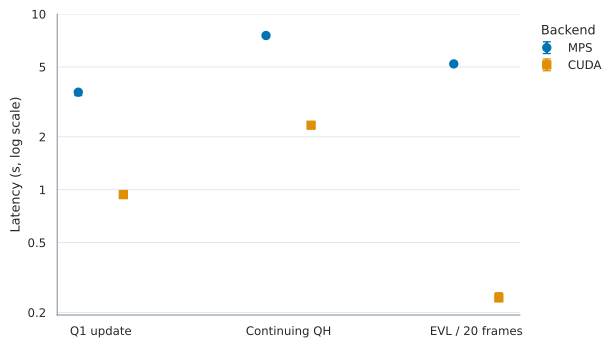
The configured CUDA host has shorter median transactions for all three cached workloads. MPS/CUDA latency ratios are 3.83× for Q1, 3.24× for continuing QH and 21.46× for egocentric voxel-lifting inference. These compare the measured M5 Max and RTX 3080 Ti hosts, including named MPS CPU fallbacks; they do not specify current hardware availability.
Open full-size figure; zoom to inspect labels
Larger ratios mean longer MPS transactions. Each workload/backend has three fresh trials, three warmups and ten synchronized timed operations per trial: 180 observations overall. p10/p90 bars describe correlated timings, not confidence intervals.
Training timing covers forward, loss, backward, clipping and optimizer update. EVL uses a frozen 20-frame inference input. Loads, construction and transfers are outside the steady timer. This is not complete training-fit or rollout throughput. Host CPU scheduling was not matched, and the lifter samples depths even in evaluation mode.
Use these measurements to budget these cached tasks on the commissioned runtimes. Two separate next gates remain: numerical equivalence of the intended model/precision path, and end-to-end throughput including data, transfers, validation and reporting. The earlier numerical gate failed at its own source revision and was not retested by this timing study.
The fleet companion records canaries, transport and layout inspection. Those operational checks do not turn timing into scientific pooling permission or qualify unattended service recovery. Future cluster use is prospective.
The protocol and six native
receipts, all timings and
immutable input summary bind source and runtime.
aria_nbv.reporting.m5_benchmark.load_bundle validates the
supplied observations; render and the existing
latency/trajectory functions regenerate a new presentation. Exact
measured source is retained as a Git bundle; tensors/checkpoints needed
to rerun measurement remain separately available private inputs.
| Finding / evidence | RQ | Thesis section | Coverage / gap |
|---|---|---|---|
| Cached host latency | RQ2/RQ3 context | sec:thesis-experimental-design | Outside scope: operational resource evidence, not a scientific RQ result |
Previous primary report retains its complete narrative, exact tables and original figures. This 15 October revision is an authored synthesis, not a new experiment or a change to the numerical snapshot. Original sealed report.
Experiment index and evidence routes. Missing/private parents remain explicit in the native campaign owner; historical versions retain their original dates and scientific identities.
Scientific snapshot and attempt identities remain those of the cited experiment. Report synthesis: 15 October 2026; restored to the domain/date owner: 16 October 2026.