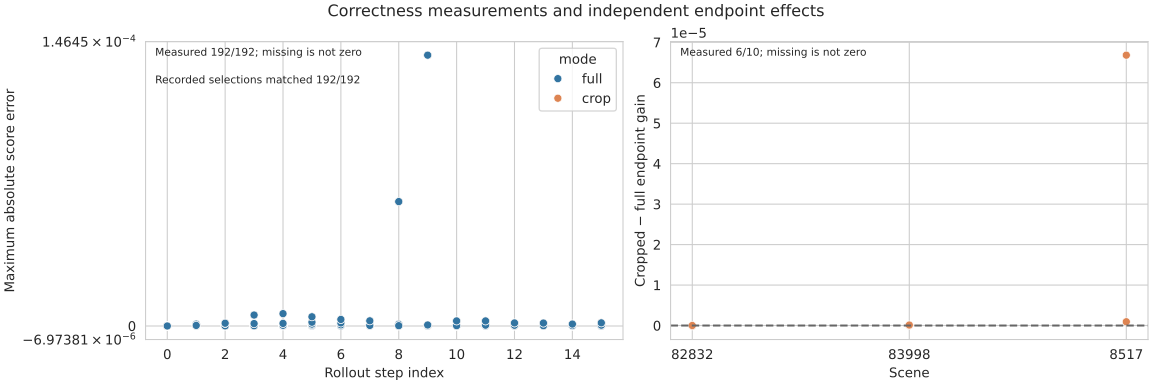
All six reached renderer pairs failed frozen trace equivalence, despite matching selected action identities. The six pairs cover three physical scene roots with two nested seeds each. Twelve of twenty intended rollouts reached H16; eight unreached intentions were withheld. The negative checkpoint is preserved and is not relabelled by the later repair.
Open full-size figure; zoom to inspect labels
Matching all 96 selected actions was insufficient: the frozen contract also checks candidate scores, observations and downstream state. Individual store and endpoint-audit validity does not imply paired transition equivalence.
The camera-stable follow-up uses a changed acquisition source and closes its own finite-roster comparison. That later result does not make the earlier six pairs pass. Keeping the failure explains why camera/observation identity is part of the measurement contract rather than a cosmetic detail.
Next: retain the repaired recipe's specific conditions when using its crop option; rerun qualification for changed cameras, meshes or acquisition semantics. A runtime improvement alone cannot establish measurement preservation.
The original
negative checkpoint links full tables, geometry, endpoint audits and
the portable archive. The native owners are
oracle.pipelines.renderer_experiment_report,
reporting.renderer_rollout_figures and
reporting.renderer_trajectory_figures. Historical
portability proofs have their own dated supplements; this narrative does
not rerun acquisition.
| Finding / evidence | RQ | Thesis section | Coverage / gap |
|---|---|---|---|
| Failed equivalence despite selected-action match | RQ1 | sec:thesis-results | Covered: negative predecessor preserved |
Previous primary report retains its complete narrative, exact tables and original figures. This 15 October revision is an authored synthesis, not a new experiment or a change to the numerical snapshot. Original H16 geometric viewer.
Experiment index and evidence routes. Missing/private parents remain explicit in the native campaign owner; historical versions retain their original dates and scientific identities.
Scientific snapshot and attempt identities remain those of the cited experiment. Report synthesis: 15 October 2026; restored to the domain/date owner: 16 October 2026.